Article Originally Published Here.
Hundreds of security professionals and security consultants have spoken: Organizations put more emphasis on executive protection (EP) today than they did two years ago.
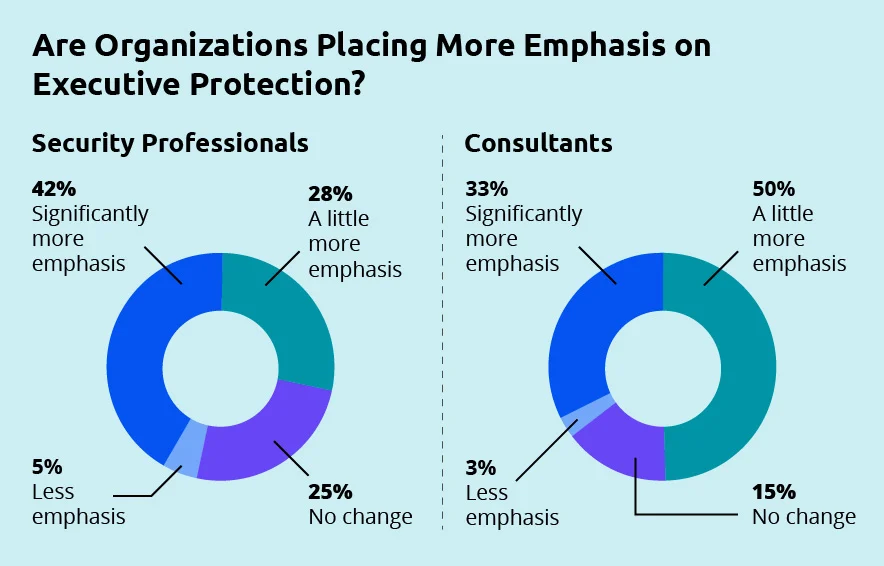
In results from the 2025 ASIS International executive protection survey, a research project sponsored by Everbridge, 42 percent of security professionals say EP is getting significantly more emphasis, and another 28 percent say it is getting a little more emphasis. For consultants in the survey, the ratio of “significant” versus “a little” more emphasis for executive protection flips, but still, 88 percent of consultants said EP was getting at least a little more emphasis.
It is not hard to see why this is the case. The high-profile murder of UnitedHealthcare CEO Brian Thompson in New York City in 2024 had a chilling effect on corporate leaders. The two leading reasons for the increased emphasis cited in the research were “increases in public threats” (72 percent) and “high-profile incidents in the news” (69 percent).
And yet, despite the increased emphasis, the research shows that the biggest impediment to deploying substantive and effective executive protection programs is the executives themselves.
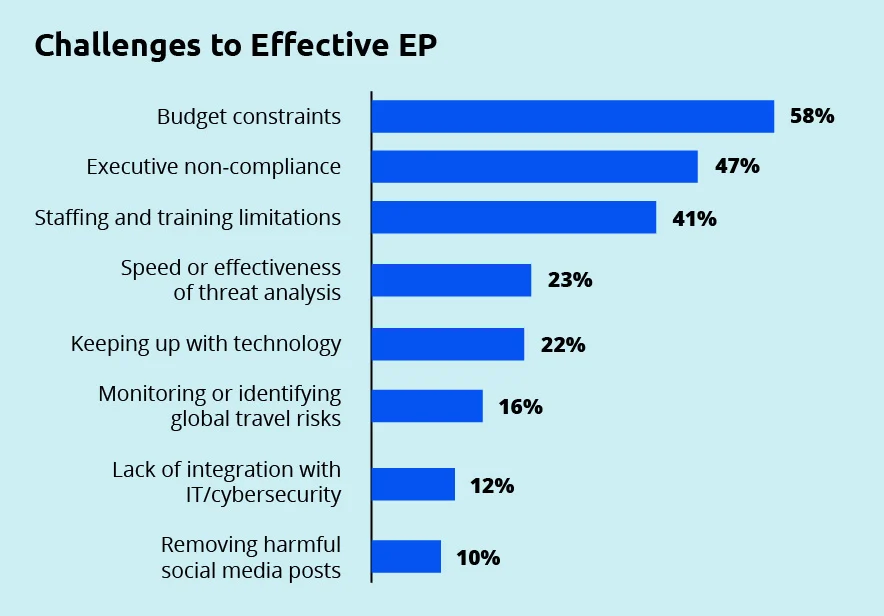
In the survey, security professionals were given a list of eight potential challenges standing in the way of effective EP and asked to choose the three biggest ones they face. At 58 percent, budget constraints topped the list, and at most companies, top-level executives control the budget. The second-most cited challenge was “executive noncompliance” at 47 percent.
Communicating the Value of Executive Protection
“You know, everybody, regardless of what your role is in security, everybody will tell you that the budget is the problem,” Tracy Reinhold, chief security officer at Everbridge, said during a webinar discussing the research results. (Disclosure: Everbridge sponsored the research project.) “And part of the reason that the budget is the problem is because we are not especially good at building a business case.”
There is no disputing that the things that are valued get the budget. It’s true that in EP, executives need to see the value in the function before budget will be tied to the function’s effectiveness. However, this is a dual failure: The executives who would receive protection either control the purse strings or have significant sway over them. However, it’s also incumbent on security professionals to show the value of EP in order to justify the expense, and the research suggests security is not doing what it needs to be doing to be successful at this task.
The research compiled a list of 22 executive protection practices and executive protection technical capabilities, and asked security professionals if they deployed the practice or capability (asking if they had done so fully, partially, or not at all) and to rate the importance of each practice or capability (asking if it was highly important, somewhat important, or not important). Below is that full list of 22 in order of how important security professionals thought the capability or practice was. There is a lot of useful benchmarking information in the table, but focus on the two highlighted areas.
| Capability or Process | In Place? | Importance | |
| Monitoring online threats or expressions of anger at specific location, organization, or executive | Full—51 percent Part—38 percent None—12 percent | 2.57 | |
| Real-time open-source intelligence (OSINT), social media monitoring, and digital threat detection | Full—50 percent Part—38 percent None—10 percent | 2.55 | |
| Travel destination threat assessments | Full—53 percent Part—33 percent None—13 percent | 2.47 | |
| Vetting contractors (such as drivers, close protection, etc.) at travel destinations | Full—51 percent Part—29 percent None—19 percent | 2.45 | |
| Surveillance or manned security at private locations (residence, office, venues) | Full—51 percent Part—31 percent None—19 percent | 2.42 | |
| Protection of digital assets/secure communications | Full—42 percent Part—38 percent None—20 percent | 2.42 | |
| Security training and briefings customized per user | Full—53 percent Part—35 percent None—12 percent | 2.38 | |
| Predictive risk analytics (risk escalation forecasts) | Full—39 percent Part—41 percent None—21 percent | 2.38 | |
| Multi-channel alert system (SMS, app, email, VoIP integration) | Full—48 percent Part—31 percent None—21 percent | 2.35 | |
| Behavioral threat profiling and anomaly detection | Full—33 percent Part—38 percent None—28 percent | 2.32 | |
| Secure transportation on a daily basis | Full—49 percent Part—28 percent None—22 percent | 2.32 | |
| Monitoring personal reputation of the executive | Full—44 percent Part—38 percent None—19 percent | 2.32 | |
| Sending advance agents to unfamiliar locations deemed at risk | Full—41 percent Part—33 percent None—26 percent | 2.32 | |
| Location-based geofencing alerts and tracking | Full—42 percent Part—31 percent None—25 percent | 2.26 | |
| Close protection agents working with the executive on a daily basis | Full—45 percent Part—28 percent None—27 percent | 2.20 | |
| Automated situational reports and threat, vulnerability, and risk (TVR) report generation | Full—31 percent Part—33 percent None—36 percent | 2.19 | |
| Digital footprint monitoring and sentiment analysis | Full—33%; Part—36%; None—32% | 2.19 | |
| Travel authorization, risk, and itinerary monitoring | Full—53 percent Part—34 percent None—13 percent | 2.05 | |
| Automated after-action reports, data repository, and analytics | Full—26 percent Part—36 percent None—37 percent | 1.99 | |
| Customizable dashboard and team permission levels | Full—28 percent Part—28 percent None—44 percent | 1.97 | |
| Data logging and exportable analytics for EP return on investment (ROI) calculation | Full—23 percent Part—22 percent None—56 percent | 1.90 | |
| Close protection agents working with family (immediate and extended) of the executive | Full—29 percent Part—29 percent None—42 percent | 1.84 | |
The two highlighted areas are “automated after-action reports, data repository, and analytics” and “data logging and exportable analytics for executive protection return on investment calculation.” Out of all 22 practices and capabilities on the survey, these two would be the most useful in building the business case for EP. But security professionals ranked them 19th and 21st in importance, and more said the capabilities were not important than said they were very important. These are the very tools that security professionals need to show the value of executive protection.
“The after-reports, the analytics, those things are so important to improving your prospects,” Reinhold said. “If you skip those steps, you’re actually putting yourself at a deficit.”
In “Speaking the C-Suite Language: A Strategic Approach to Security Budgeting,” Ryan Schonfeld, founder and CEO of security technology company HiveWatch, wrote that “security leaders often fall into the trap of thinking about each function at a granular level without a focus on governance-level business planning.”
When talking about budgets for security programs, he suggests security professionals be prepared to answer these questions:
- Can this investment be delayed?
- Is there a cost-effective alternative?
- Is there something we already have that might address this need in the short term?
- How does this align with our organizational key performance indicators (KPIs)?
- Can other departments benefit?
The goal is to show that you have thought through and considered these questions.
In one open-ended question in the survey, a consultant said, “Executive protection is often misunderstood, which has led to underinvestment or poorly implemented programs. One common myth is that executive protection is only for celebrities or politicians. In reality, corporate executives, especially those making high-stakes decisions or are involved in public-facing controversies, are at high risk.” (Note: the survey was anonymous, so the consultants cannot be named. The quotes were edited lightly for clarity.)
Other consultants dove deeper into the misperception: “Many corporate security leaders misunderstand executive protection as merely a high-visibility security detail or bodyguard function,” one said. Another explained, “True executive protection is a proactive risk management discipline that blends intelligence, logistics, behavioral analysis, medical preparedness, and operational planning to ensure the principal’s safety without disrupting their lifestyle or productivity.”
When an executive says protective efforts are not worth it, Reinhold recommended coming back with the questions: “Don’t you have a fiduciary responsibility to your shareholders? If something happens to you, what do you think happens to the stock price?”
He realized, of course, these are difficult conversations. “You may have to be a bit creative,” he said. “You need to be able to understand what the triggers are for those executives, and you need to be able to build a repeatable business case.”
The Resistant Executive
Darcy Leutzinger is the senior vice president and director of security at United Wholesale Mortgage, and he is an expert in executive protection. He says the critical element of building an effective EP program is building a relationship with the executive.
“The most important thing is establishing expectations very early in your relationship with the CEO,” he explains. “They are surrounded by ‘yes’ men all the time. That’s not your job. You need to tell the executive what you need to tell them, not what they need to hear—not necessarily what they want to hear. You’re there protecting their best interest—them, the company, their family.”
He notes that at first, there will be times that seem awkward, where the executive is not sure what to make of the protection lead and vice versa. “But trust is built over time,” Leutzinger says, “and confidence will follow after that. Go slow and let the relationship grow over time.”
He does advise being particularly mindful of one aspect: executives’ time.
“Time is crucial to them,” he says. “That’s the one thing they cannot control, so when you’re with them, tell them just what they need to hear and don’t carry on long conversations or overburden them with unnecessary information. Be fast, be done, and be out the door. That’s the best thing you can do, and they’ll respect you for it.”
Another tricky conversation is when the EP risk assessment dictates that protection is need not just during travel or in the office, but also at the executive’s home.
“An executive’s spouse has the power to almost singlehandedly kill an executive protection program,” Tim Wenzel, CPP, associate managing director for the enterprise security risk management (ESRM) practice at Kroll, told Security Management for an article published earlier this year. “When you get involved with the family side and you get involved with residences, you have to understand the environment they want so you can maintain it. Then you have to choose a team and train them to recreate that environment.”
One key is flexibility. Wenzel used the example of an executive spouse who does not like the idea of being constantly surveilled when playing with the children in the yard. The protective detail could turn off the cameras during those periods and step up a nearby foot patrol to accommodate.
The survey asked another open-ended question of security consultants: “What is your best advice for corporate security leaders who face executives who resist certain executive protection processes or methods?”
One of the consultants in the survey offered these tips for how to use education, relationship-building, and strategic communication to overcome executive objections:
- Lead with risk-based justification.
- Align protection with business continuity and duty of care.
- Customize the approach to the executive’s profile and preferences.
- Build trust through relationship management.
- Use influencers and peer endorsements.
- Emphasize confidentiality and professionalism.
Another consultant touched on almost all the points brought up in the 97 responses with this insight:
“My best advice is to align protection strategies with the executive’s business goals and personal priorities. Avoid using fear-based messaging. Instead, communicate the value of protection in terms of business continuity, reputation management, and operational efficiency. Build trust by being discreet, professional, and solution-oriented. Involve them in decision-making processes, offer options rather than ultimatums, and always back your recommendations with clear, real-world examples and risk intelligence. Ultimately, the key is to position security as an enabler—not an obstacle—of their success.”