Article Originally Published Here.
here are 1.27 million security guards working in the United States right now. That sounds like a large number until you realize the industry generates 162,300 job openings every single year, almost entirely because people keep quitting. The Bureau of Labor Statistics projects 0% employment growth through 2034. The workforce is not expanding. It is churning.
Security guard turnover hit 77% in 2024, according to ASIS International. Some contract security firms report rates as high as 300%. That means certain companies replace their entire guard force three times in a single year. And while the industry hemorrhages people, the threats it is supposed to stop are not slowing down. Workplace violence, property crime, and active threat incidents continue to climb.
The security guard shortage is not a future problem. It is a right-now problem. And the organizations still relying exclusively on human guards to watch every camera feed, patrol every hallway, and respond to every alert are building their security programs on a foundation that is actively crumbling.
The Numbers Behind the Security Guard Shortage
The math is brutal. The median security guard in the United States earns $38,370 per year, according to the Bureau of Labor Statistics. A 2025 analysis by the Center for American Progress found that the median security guard in 2022 earned two cents per hour less, in inflation-adjusted terms, than they did in 2003. Over that same period, rent costs grew 14.3%.
Read that again: security guards are earning less in real dollars than they did two decades ago, while everything around them costs more.
In New York City, the median security guard wage represents less than 40% of the Area Median Income, qualifying guards as “very low-income” for affordable housing purposes. These are the people we ask to be the first responders to potentially dangerous situations, to work overnight shifts and holidays, to stand post alone in isolated environments. And we pay them less than warehouse workers and delivery drivers.
The result is predictable. When Amazon, FedEx, and Walmart offer comparable wages with better hours and less personal risk, security becomes a hard sell. The $49.1 billion U.S. security services industry is not struggling because there are not enough people. It is struggling because it cannot keep the people it has.

BY THE NUMBERS
The Security Guard Workforce: A System Under Pressure
77%
Annual Guard Turnover Rate
ASIS International, 2024
162K
New Job Openings Per Year
Bureau of Labor Statistics
0%
Projected Employment Growth Through 2034
Bureau of Labor Statistics
$38K
Median Guard Wage — Less Than 2003, Inflation-Adjusted
Center for American Progress, 2025
What Actually Happens When Guards Quit
The consequences of the security guard shortage extend far beyond empty guard booths. When a position goes unfilled for days or weeks, organizations face cascading failures in their security posture:
Camera feeds go unwatched. The average enterprise facility has dozens or hundreds of cameras. Without enough guards to monitor them, those cameras become exactly what unmonitored cameras have always been: recording devices, not prevention tools. They document what happened. They do not stop what is happening.
Patrol coverage collapses. When a facility loses a guard, the remaining staff either stretch thinner or entire patrol routes get dropped. Parking lots, loading docks, stairwells, and perimeter fences go unwatched during the exact hours that criminal activity peaks.
Institutional knowledge walks out the door. A guard who has worked a facility for two years knows its rhythms, its blind spots, its problem areas. When that guard leaves and is replaced by someone on their first week, the security program effectively resets. With 77%+ turnover, most guards never reach the point where they truly understand the facility they are protecting.
Fatigue and alert overload spike. The guards who remain absorb the workload of those who left. They work longer shifts, monitor more screens, and respond to more alerts. Human attention degrades after 20 minutes of continuous monitoring. Asking a guard to watch 30 camera feeds for a 12-hour shift is not a security strategy. It is a hope and a prayer.

Why Hiring Your Way Out of This Does Not Work
Some organizations respond to the guard shortage by raising wages, offering bonuses, or contracting with staffing agencies. These are reasonable tactics, but they do not solve the structural problem.
Even when guards are recruited successfully, training takes time. The learning curve at a complex facility like a hospital, manufacturing plant, or corporate campus can take months. And given the turnover rates, many guards leave before that investment pays off. The industry is trapped in what amounts to a permanent recruiting-training-losing cycle, spending enormous resources just to maintain the status quo.
Contract security firms face the same pressures. They compete for the same shrinking labor pool, and their margins are thin enough that significant wage increases require passing costs to clients. The global manned guarding market grew by $6.5 billion between 2025 and 2026, but that growth reflects rising costs, not expanding coverage. Organizations are paying more and, in many cases, getting less.
The uncomfortable truth is that the security guard model, as traditionally structured, is not scalable. You cannot hire your way out of a labor crisis when the labor does not want the job at the price you are offering.
AI Video Analytics: Force Multiplier, Not Replacement
The conversation about AI video analytics and security staffing often gets framed as a binary choice: humans vs. machines. That framing misses the point entirely. The most effective security programs in 2026 are not choosing between guards and technology. They are using technology to make their existing guards dramatically more effective.
Here is what that looks like in practice.
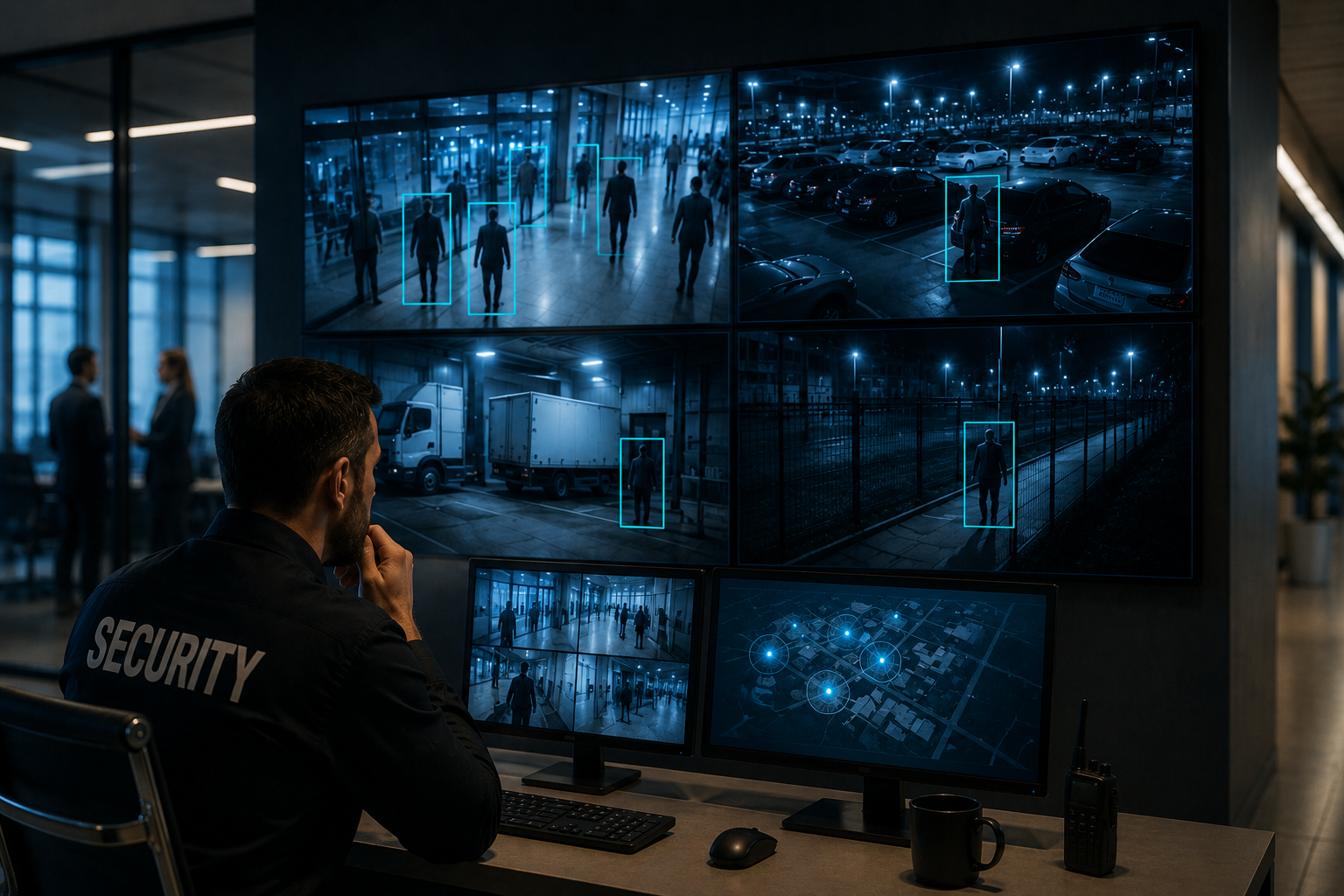
AI watches every camera, all the time. Where a human guard might realistically monitor 4 to 8 camera feeds before attention degrades, AI-powered video analytics processes every frame from every camera simultaneously. It does not get tired. It does not look at a phone. It does not take a bathroom break. When the system detects an anomaly, like a person in a restricted area, a weapon, or aggressive behavior, it alerts the human team within seconds.
Guards focus on response, not monitoring. When AI handles the detection layer, guards are freed from the mind-numbing task of staring at screens for hours. Instead, they do what humans actually do well: assess complex situations, de-escalate confrontations, communicate with law enforcement, and make judgment calls that require empathy and context. This is a better use of their skills and, critically, it makes the job more engaging, which helps with retention.
Coverage gaps disappear. A facility that once needed five overnight guards to cover its camera system and patrol routes might achieve equal or better coverage with two guards supported by AI analytics. The technology covers the surveillance gap while humans handle the physical response. When a guard calls out sick, the AI does not call out with them. The detection layer remains constant.
False alarms drop dramatically. Alert fatigue is one of the most corrosive forces in physical security. When guards receive hundreds of false alarms per shift, they stop taking alerts seriously. Multi-stage AI validation can reduce false alarms by 50% or more, meaning that when an alert does reach a human, it is far more likely to be real and worth acting on.
COVERAGE COMPARISON
Human-Only vs. AI-Augmented Security
HUMAN-ONLY COVERAGE
—Monitors 4–8 feeds effectively before attention degrades
—Detection reliability drops sharply after 20 minutes of monitoring
—Coverage gaps during shift changes, breaks, and sick calls
—Alert fatigue leads to dismissal of legitimate threats
—$75K–$100K fully loaded cost per guard position per year
AI-AUGMENTED COVERAGE
+Processes every frame from every camera simultaneously, 24/7
+Consistent detection performance regardless of shift length
+Zero coverage gaps — AI layer is always active regardless of staffing
+Multi-stage validation reduces false alarms by 50% or more
+Guards reallocated to response, de-escalation, and decision-making
The Financial Case Is Already Clear
Organizations evaluating the ROI of AI security often discover that the technology pays for itself faster than expected, primarily through reduced guard labor costs.
Consider a mid-size corporate campus running three shifts of security coverage, seven days a week. Fully loaded guard costs (wages, benefits, training, uniforms, supervision, turnover-related recruiting) can easily reach $75,000 to $100,000 per guard per year. A facility running 10 guard positions around the clock is spending north of $750,000 annually, and a significant chunk of that is just replacing the guards who keep leaving.
AI video analytics layered onto existing camera infrastructure does not require new cameras in most cases. It uses the security cameras already installed and adds an intelligence layer on top. The result is often a reduction from 10 guard positions to 5 or 6, with better detection coverage than the original 10 provided, because the AI never stops watching.
The savings compound over time. Fewer guards means less turnover churn, less recruiting spend, less training overhead, and fewer coverage gaps during transition periods. The technology cost is predictable and does not fluctuate with labor market conditions.
What Smart Organizations Are Doing Right Now
The organizations leading the shift toward AI-augmented security are not eliminating their guard teams. They are restructuring them.
Schools and universities are deploying AI weapon detection systems that alert security teams the moment a firearm is visible on camera, rather than relying on a guard to notice it on one of dozens of screens. This is especially critical in educational environments where the threat landscape has intensified while security budgets remain constrained.
Hospitals facing a workplace violence epidemic are using AI to monitor emergency departments, psychiatric units, and parking structures where incidents most commonly occur. The AI provides continuous detection in high-risk areas that would otherwise require dedicated guard posts around the clock.
Warehouses and manufacturing facilities are combining AI safety monitoringwith security functions, using the same camera system to detect both safety hazards (forklift near-misses, slip risks) and security threats (unauthorized access, perimeter breaches). One camera system, multiple layers of protection, fewer personnel needed.
Retail environments dealing with the $132 billion shrinkage problem are using AI to detect theft-related behaviors in real time, freeing loss prevention teams to intervene before merchandise leaves the store rather than reviewing footage after the fact.
The Guard Role Is Evolving, Not Vanishing
Let us be direct about something: security guards are not going away. The BLS projects stable employment through 2034, and the skills that make a great security officer, situational awareness, interpersonal communication, crisis management, physical presence, are things that AI genuinely cannot replicate.
But the guard role is evolving. The guard of 2030 will look more like a security operations specialist than a traditional watchperson. They will manage AI-driven alert queues, coordinate with automated systems, make high-stakes decisions based on AI-surfaced intelligence, and focus their physical presence where it matters most.
This evolution is good for guards, too. Positions that involve technology management, decision-making, and incident response command higher wages than positions that involve standing at a desk watching screens. As the role becomes more skilled, compensation will follow, which helps address the very turnover problem that created this crisis in the first place.
The Organizations That Wait Will Pay the Most
The security guard shortage is not going to reverse itself. Demographic trends, wage competition from other industries, and the inherent difficulties of security work all point in one direction: the labor pool will remain tight for years.
Organizations that continue to rely entirely on guard labor will spend more each year to maintain the same (or worse) coverage. Those that integrate AI-powered detection and monitoring into their security programs will achieve better coverage at lower cost, with the added benefit of a security team that is smaller, better compensated, and more focused on the work that actually requires a human being.
The question is not whether AI will reshape physical security staffing. It already is. The question is whether your organization will make that shift proactively, on your terms, or reactively, when the next guard quits and you cannot find a replacement.