Article Originally Published Here.
When I spoke to my childhood best friend over winter break, he told me about the desk he hid under and the fire extinguisher he planned to use as a weapon if the Brown shooter rushed the classroom he was hiding in. He spoke about how the time passed slowly — minute after minute, hour after hour — as his group chats buzzed with friends and classmates checking in on each other. “I never thought it would happen at Brown,” he told me.
After the tragedy in Providence, many Yalies questioned whether a similar shooting could happen at Yale. My conversation with friends switched from grief to logistics: Where would I run in Sterling? Which doors lock in Bass? How long would it take for help to arrive? Some recommended the university cancel exams, while others, including me, wanted to see Yale tighten library access, add patrols, and install more cameras. One response is clear: Arm and train campus security guards to confront a shooter on scene.
Student panic kept returning to the same uncomfortable fact. On a college campus like Yale’s, there is a window at the beginning of an attack when students are on their own.
The University can tell students to hide under desks, barricade doors, or run, but this is not a plan to stop a shooter. It is a plan to survive long enough for someone else to stop him. To save the most lives, the University must work to close the gap between when a shooting starts and help arrives. That means arming Yale’s security officers — so the people responsible for protecting students have the ability to confront lethal violence immediately, without having to wait for campus police to arrive.
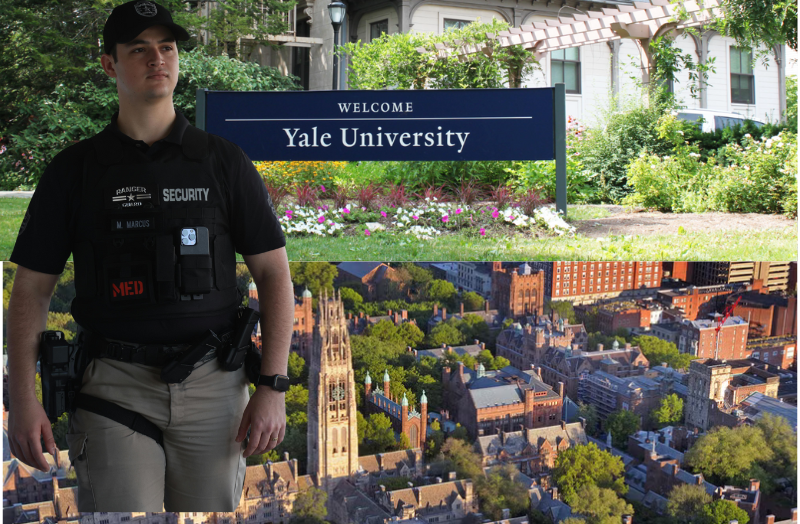
Yale Public Safety employs a department of 150 unarmed security officers tasked with being the “eyes and ears of the Police Department by patrolling buildings and parking facilities,” according to a Yale website. Though Yale security officers work in conjunction with Yale police, they are a separate department without the authority to use reasonable force, arrest individuals, or detain people. Students know and appreciate the familiar neon yellow jackets of security officers who patrol campus on bikes and scooters. Unlike Yale police, the security officers are unarmed.
The Yale Police Department maintains a smaller force of only 93 uniformed officers, according to its website. While security officers frequently interact with students while patrolling campus on foot, bike, and segway, Yale police officers patrol mostly in vehicles and have a less visible campus presence. In the case of an active threat, security officers around campus will likely be closer to the threat than Yale police.
I spoke with various elements of Yale’s security infrastructure across campus in December. Library security staff explained that in the event of an active shooter in Sterling Memorial Library, their first function is to alert police and direct students to safety. They are not tasked to engage the shooter, leaving students as sitting ducks until Yale police arrive. Even if they wanted to, library security staff are unarmed and could thus do little to stop a shooter already in the building.
What if a shooter barges into the Starr Reference Room? Within seconds of the first shots being fired, library security staff would hopefully alert Yale police, who might arrive at the reading room 90 to 120 seconds later. How many students might have been shot by then?
A lot.
What if I were sitting in Sudler Recital Hall or Marsh Lecture Hall and a shooter rushed in? The closest security asset would likely be a Yale Security officer. When they arrive, will they be able to successfully stop a shooter with a baton or taser? Probably not.
I am astonished that the security officers tasked with providing us safety and security services could do little in the event of a shooter other than notify Yale police. It should astonish you, too.
Now, in the event of an active shooter, a speedy arrival of Yale police officers is our best bet to engage and disarm the threat. How long would they take? The median national police response time to an active shooter incident is 3 minutes. At Brown University last week, local police arrived in just under three minutes — beating the national median — but after the shooter had departed.
As active shooter events become more common, Yale Public Safety must work to close the gap between when a shooting begins and when a credible armed response can arrive to address it. Every second could cost lives.
There are two apparent paths forward. The first is to arm the security assets already in place. Train current library and campus security officers to operate firearms, and expect them to respond to active events immediately. A library security officer told me this week that he would be worried about missing the threat and accidentally shooting bystanders. Yale Public Safety could consider arming its staff with less lethal handguns.
The second option is to increase the size and presence of the Yale Police Department, placing armed police officers in major buildings and on patrols around campus. Why shouldn’t an officer or two be stationed in Sterling Memorial Library, the Schwarzman Center, or Kline Tower? Walking into a 500-person class in Marsh Lecture Hall, I would be reassured to see an officer at the entrance, serving as both a deterrent and a first responder.
I can understand some reasons Yale maintains unarmed security teams. Security officers are paid less than Yale police officers. Yale may also hope to appease students who have negative perceptions of police by supplementing police presence with less threatening security officers. Yet, as long as security officers remain unarmed and unable to sufficiently respond to active threats, what’s their point?
The moment calls for campus security prepared for more than crowd control, door unlocks, and intoxication calls. It calls for armed security. Will Yale meet the moment?
I do not write this to critique Yale’s security personnel. I am grateful every day that they put themselves on the line for my safety. I ask each reader that you take a moment over the coming months to express thanks to the officers of our security departments. Chat with them, laugh with them, get to know them. Show them the people they are tasked with saving, and get to know those who may one day save your life. It will brighten their days, and, I promise, yours too.