Article Originally Published Here.
Missouri Republicans say the new armed guards would improve responses to threats, while Democrats warn more guns won’t make schools safer.
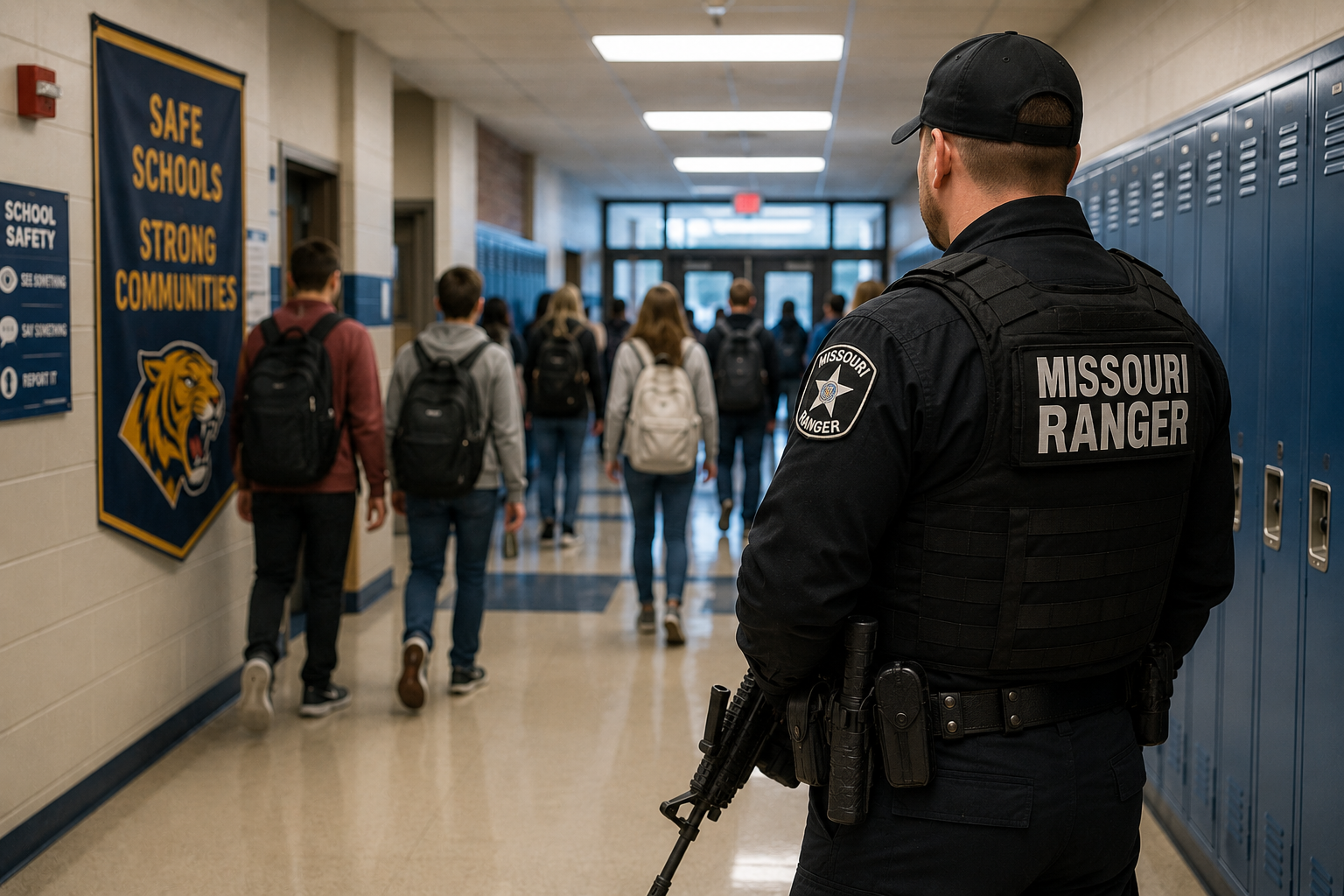
A bill to create a new faction of school protection officers with “physical fitness superior to a U.S. Marine” got final approval from Missouri lawmakers in the final days of the legislative session.
The legislation seeks to allow schools to hire volunteer or paid guards called “Missouri Rangers” who could carry a gun on school grounds.
The bill’s sponsor, Republican state Sen. David Gregory of Chesterfield, told senators he wanted to give schools “a choice to have a higher-trained armed guard.”
He compared current protection officer requirements to those of a “Walmart guard with a gun.” Currently, schools can appoint teachers and administrators as school protection officers, allowing them to carry a gun or “self-defense spray device” with training and a concealed carry permit.
School protection officers must complete at least 112 hours of training, according to a Department of Public Safety rule. The state also has school resource officers, who are law enforcement officers with an additional 40+ hours of training related to school safety.
Gregory’s legislation proposes a maximum of 160 hours of training, specifying that the program must include lessons on “close quarter combat,” bomb and arson training, de-escalation, among others.
Prior to training, rangers must pass a physical fitness test. Those 35 and younger must “complete a minimum of 40 pushups in less than one minute” and run one and a half miles in less than 12 and a half minutes. The legislation asks the state’s Peace Office Standards and Training Commission to identify lower standards for older applicants.
The bill’s first pass through the Senate drew little opposition, garnering support from groups like the St. Louis County Police Association at its first committee hearing. In early April, just two senators voted against the proposal, but Senate Democrats unanimously voted against it when it returned to the chamber last week, with less than a day before the session adjourned for the year.
House Democrats unanimously rejected the proposal, uncomfortable with the proposition of having more firearms in schools.
“The answer to guns in schools is not more guns in schools,” said state Rep. Elizabeth Fuchs, a St. Louis Democrat, advocating instead for mental health support for students.
Their arguments did not sway House Republicans, who unanimously voted in support of the bill.
State Rep. Burt Whaley, a Republican from Clever, has experience training school staff on how to respond in the event of a shooting. The key benefit of having a ranger, he said, was the ability to respond quickly to threats.
At one school he trained, local law enforcement estimated it could take up to 45 minutes for them to arrive.
“It is typically another person with a gun that knows how to use it, that’s trained how to use it… They’re usually the ones that are able to subdue (a threat),” he said.
The bill follows other proposals passed last year that address security concerns, such as laws directing schools to share emergency operations plans with local law enforcement and to report school safety incidents to the state’s education department.
Some of the provisions passed in last year’s legislation have yet to be implemented due to a lack of funding, such as requirements to equip schools with bleeding-control kits and to train staff to apply a tourniquet.
Gov. Mike Kehoe has until mid-July to sign or veto bills before they become law.