Article Originally Published Here.
Workers say misconduct is often overlooked when top performers are involved
A new report reveals a troubling disconnect between how protected employees feel at work and the reality of the misconduct they witness and experience.
TalentLMS research, conducted in November 2025 with 1,000 employees across various industries, found that while 71% of workers surveyed feel protected in their workplace, only 38% reported not witnessing any workplace misconduct or mistreatment in the past 12 months.
The most common form of workplace misconduct identified was incivility or disrespect, with 36% of employees witnessing it and 33% experiencing it firsthand. Professional or social exclusion ranked second, with 29% reporting witnessing it and 24% experiencing it.
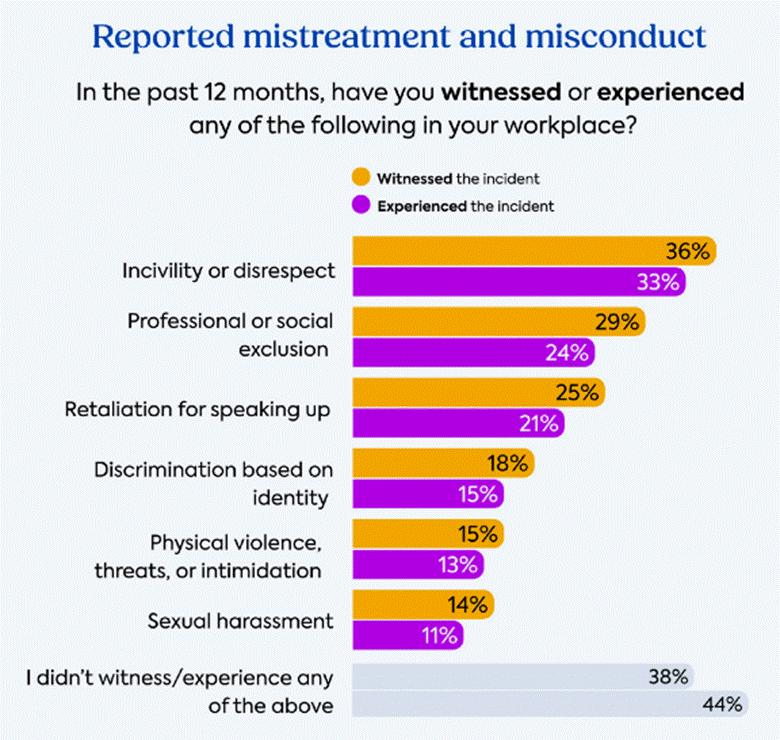
The report also uncovered serious breaches of workplace safety: 15% of employees witnessed physical violence, threats, or intimidation, while 13% experienced it. Sexual harassment was similarly prevalent, witnessed by 14% and experienced by 11% of respondents.
A major barrier to addressing misconduct appears to be a breakdown in accountability. The data show that 62% of employees believe misconduct is more likely to be overlooked when the person involved is a top performer or leader. Additionally, 45% have seen individuals promoted even after mistreating others.
Fear and futility keep many employees silent. Among those who witnessed or experienced misconduct but did not report it, 56% believed speaking up would not make a difference, while 36% feared retaliation.
Resolving issues and strengthening workplace safety
A 2024 report reflected similar outcomes. Even when companies heavily invest in diversity, equity, and inclusion initiatives, power abuse remains a significant driver of toxic workplace environments. Workplace psychologists and HR specialists note that when managers or leaders misuse their authority to intimidate or control employees, it undermines psychological safety and can entrench misconduct.
When incidents are reported, outcomes remain inconsistent. Only 27% of employees who reported misconduct say action was taken, while 16% said their reports resulted in no action at all.
Despite these challenges, compliance training shows promise. Sixty percent of employees say compliance training has improved behavior in their workplace, and 36% believe better compliance training would reduce misconduct.
However, training coverage remains uneven. The report found that 57% of employees received workplace safety and emergency preparedness training, but only 45% received harassment and discrimination training. Twenty percent of employees reported receiving no compliance training at work in the past 12 months.
The research also examined recent pullbacks in diversity, equity, and inclusion initiatives. Twenty-seven percent of employees say their company has scaled back DEI programs, with 31% of those employees feeling less protected as a result.
The report concludes that true protection requires equal accountability and transparent outcomes. Organizations must decide whether to protect high performers or protect trust in workplace fairness, as inconsistent enforcement undermines credibility and creates conditions where more serious violations can take root.